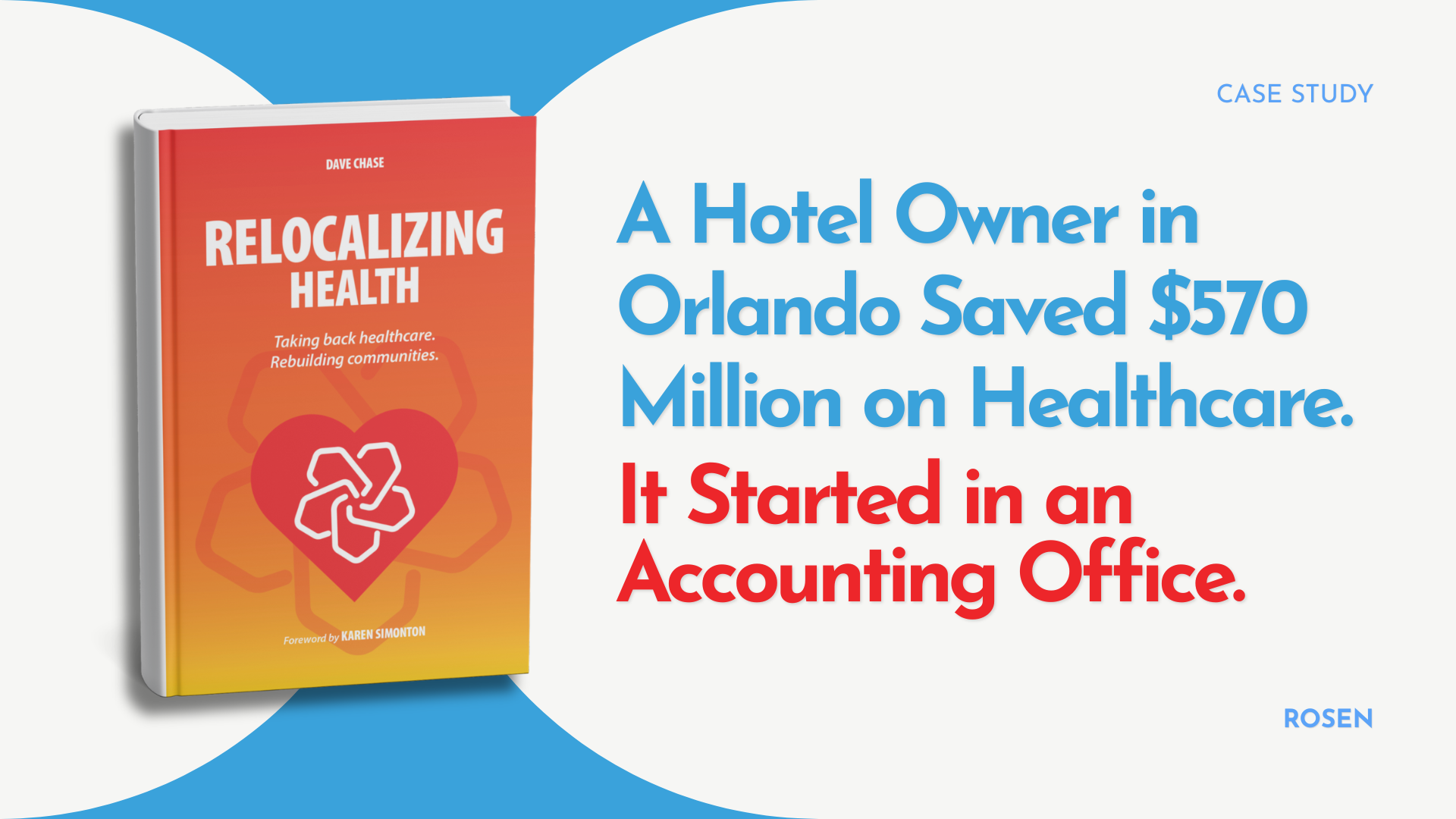
Rosen Hotels & Resorts is a family hospitality company in Orlando. They are also proof that the biggest problems in healthcare have already been solved, just not by the companies you’d expect to solve them.
Harris Rosen is the son of immigrants. He grew up on New York’s Lower East Side, where his father spent three decades as a safety officer at the Waldorf Astoria. During the oil crisis in the 1970s, Rosen bought a bankrupt Quality Inn on International Drive in Orlando with a modest down payment and a lot of nerve. By the early 90s he had built a real hospitality company.
And like every other employer in America, he was getting hammered by healthcare increases.
The Man at the Center of the Story
Rosen’s workforce reflected the hospitality industry in Central Florida: a lot of immigrants, many of whom had never had access to a modern healthcare system. The traditional insurance model was punishing them with high deductibles, rising premiums, and surprise bills, in an industry where people live paycheck to paycheck.
Rosen asked a question almost nobody asks: what if the hundreds of millions going into bureaucracy went to caring for people instead?
The Idea Nobody Believed
Another steep renewal increase hit in the 1990s. Rosen and his CFO, Frank Santos, now the company’s CEO, had a radical idea. Build their own healthcare delivery system. They converted part of an accounting office into a small clinic with one part-time doctor. That’s where it started, in an accounting office.
Their broker insisted they had no choice but to stay in the insurance pool. Industry veterans said an employer couldn’t deliver care without going broke or going substandard. Florida is the most expensive state in the country for healthcare, with 40 percent of the most price-gouging hospitals in the nation.
Rosen noticed something else too. The fiercer the pushback, the more he figured he was onto something. The status quo doesn’t fight that hard against ideas that don’t threaten it. This wasn’t a hotel company trying to fix healthcare. This was an employer taking responsibility for its most valuable asset, the people Rosen calls associates.
What Got Built
That accounting-office clinic became a 12,000-square-foot medical center, built at a fraction of the usual cost using fully functioning equipment bought at 10 cents on the dollar. Rosen did something almost no employer does: employees see their doctor while they’re on the clock, not on their own time. For a working-class workforce, going to the doctor on your own time can mean taking food off the table.
While the rest of the industry raised co-pays and deductibles, Rosen eliminated or greatly reduced them. When transportation was a barrier, since much of the workforce relied on public transit, Rosen gave people free rides to appointments.
Complex health needs became an opportunity, not a liability. A decade ago, 56 percent of pregnancies at Rosen were classified high risk. Today it’s between 60 and 72 percent, and the budget is balanced. Associates arrive in the system with conditions like TB and HIV, advanced maternal age, and the full range of what shows up in any American workforce. Rosen built a model to meet it.
Kenneth Aldrich, Rosen’s clinical leader since 1998, put the counterintuitive truth this way: everybody assumed giving clinicians more time per patient, smaller panels, longer visits, would lose money. Instead, thirty years of data show it lowered costs through prevention and better chronic care management. One employee summed it up simply: my doctor knows me and my family, I’m not just another number in the system.
Rosen embedded behavioral health directly into primary care, the model used by the best primary care systems in the world, which can fully address 90 percent of the reasons people enter the healthcare system in the first place. They built a stretching program for the physically demanding jobs in a hotel company and cut injuries by 25 percent. They subsidized healthy food for a workforce that needed it.
The Opioid Question
When Dave Chase wrote his second book, The Opioid Crisis Wake-Up Call, he had a hypothesis: destroy primary care in this country, and an opioid crisis follows. He asked Rosen leadership what their opioid story was. Their answer: they’d never really had an opioid program, because they’d never really had an opioid problem.
The data backed it up. Rosen’s opioid prescription rate runs at one-sixth the typical US employer rate, comparable to France and Italy, countries that don’t have an opioid crisis. The number one driver of opioid prescriptions is standard lower back pain, the second most common reason people see a doctor after cold and flu, despite no evidence that opioids do anything beyond masking pain in the short term.
The Results
Rosen’s healthcare costs have stayed essentially flat, tracking inflation, for three decades, while most employers let costs run unchecked. Per-employee costs run 55 percent below industry norms. Benchmarked against comparable Orlando hospitality employers, that adds up to $570 million and counting in savings.
The employee cost share is about $16.66 a week. Turnover, historically brutal in hospitality, runs at one-sixth the typical rate. Workers’ comp costs were cut in half. This stopped being a cost story and became a recruiting and retention story.
Where the Dividend Went
What separates Rosen from a typical cost-cutter is what happened to the savings. They didn’t pocket them. They reinvested in people, starting with employees and their kids’ college educations fully funded after a few years of service, then reaching further into the surrounding community through the Tangelo Park Program: free preschool, free daycare, free after-school programs, and fully funded college scholarships covering tuition, books, and room and board.
Kids in that program graduate debt-free, while roughly two-thirds of American college graduates carry debt. Some of the earliest kids in the program are now adults with their own kids in the program, and Rosen needs to fund fewer outside scholarships today because so many of these graduates now earn scholarships elsewhere, a direct result of the school readiness the program built.
High school graduation rates that used to be unacceptably low now sometimes hit 100 percent. The college achievement rate runs around 78 percent, in the range of Beverly Hills or other high-wealth communities. Crime dropped 80 percent. Property values rose. Economist Lance Lochner ran the numbers and found a 7-to-1 return on the investment.
The model has since spread into Parramore and the historic Eatonville neighborhood, and other Orlando employers have followed. Second Harvest Food Bank is one. The School District of Osceola County saved $21 million in its first two years and put it back into classrooms and teacher pay.
What This Means for You
Harris Rosen put it simply: if we can do this, anyone can. We’re not a giant corporation, we’re not a government agency, we’re just a mid-sized hotel company that decided to do things differently. The only question is whether others will have the courage to try.
That’s the theme of RosettaFest, and of the movement behind it. When a business saves real money on healthcare and reinvests it locally, the ripple effect outlasts the business decision itself. Kids graduate. Crime falls. Neighborhoods come back.
Pre-order Relocalizing Health by Dave Chase on Amazon now. The full Rosen story is in the book. Kenneth Aldrich and Carolyn Grant from Rosen’s care team will be in Nashville.
Get your ticket at RosettaFest.org.