It is not a policy proposal. It is not a political position. It is something already happening in communities across America, and this episode explains the two structural flaws that explain why everything else has failed.
When people hear the phrase relocalizing health, a lot of them assume it is a slogan or a policy proposal, or something that maps onto a political party depending on their preconceived notions.
It is none of those things.
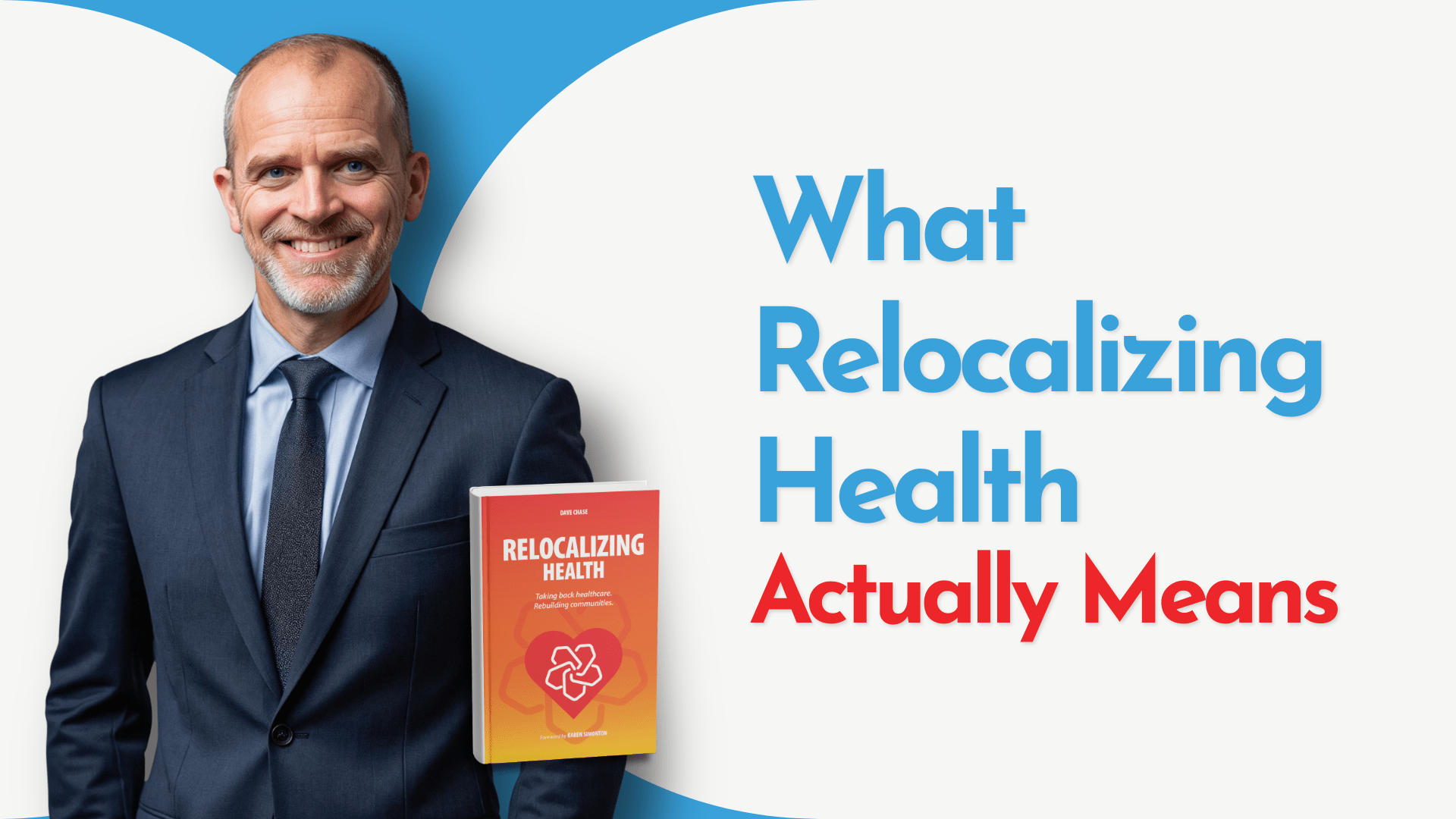
Dave Chase’s definition: treating your community’s healthcare dollars as a community resource instead of an extractive expense that leaves town the moment it is spent.
Healthcare is the biggest industry in most American communities. It is the second biggest cost item for most companies. And most of the money flows straight out to distant corporations and shareholders the moment it enters the system. Dr. Michael Fine calls it medicine as colonialism: colonial powers extracting both money and wellbeing from communities through the healthcare system.
In Ashtabula County, Ohio, a county of roughly 100,000 people, at least $450 million leaves the community every year. Dave’s framing is precise: that is not a healthcare problem. That is an economic development catastrophe.
Relocalizing means keeping that money home.
Why Reform Keeps Failing
Every major reform effort in American healthcare has disappointed, regardless of who pushed it or what ideology it carried. Dave argues in this episode that this will keep happening until two structural flaws are fixed. And no one fixes them, because most reform efforts do not even name them.
Flaw one: we fund and govern healthcare and social care in entirely separate silos. Separate money, separate governance, separate everything. This matters because 80 to 90 percent of health outcomes are determined by things outside of the healthcare setting: food, education, housing, transportation. The result is a system that profits from treating the diabetes complication but has no stake in preventing food insecurity. That bills for asthma attacks but cannot touch the mold in the apartment causing them. The incentives are baked in at the design level.
Flaw two: we govern at the wrong scale. Healthcare decisions get made either way too large at the federal or state level, or way too small at the individual provider level, expecting a primary care doctor to solve all of society’s problems in the less than an hour a year they have with a patient. The middle ground is missed entirely.
The Goldilocks Zone
The zone where community-scale health governance actually works sits between roughly 25,000 and 700,000 people. County scale. Congressional district scale. The size of Iceland. Big enough for economies of scale, small enough to see actual human beings.
The master key: when one entity invests in prevention but a different one reaps the savings, no one has a reason to invest upstream. Right-sized governance lets a community capture its own savings and reinvest them. That is the whole game.
Four examples from completely different political and governance contexts prove the point.
Jonkoping County, Sweden. Population 120,000. A county council integrated funding across medical, behavioral, and social care and reinvested the savings into home-based and preventive services. Unnecessary hospital days for complex patients fell over 90 percent. One hospital cut staffed beds by 30 percent. The cost of care in the last two years of life was cut nearly in half.
The Nuka System in Alaska. Tribal self-governance plus a unified budget across medical, behavioral, dental, and social care. ER visits down 43 percent. Hospital admissions down 53 percent. Went from the worst health outcomes in America to some of the best.
Rosen Hotels in Orlando. An employer-scale cooperative operating within a community. Savings from keeping healthcare inflation in line with regular inflation poured back into employees and the surrounding neighborhood for decades.
Ashtabula County, Ohio. Public and private employers cooperating at county scale. $2.4 million saved in year one by the 8th poorest school district. The model rippling across the county and beyond.
Sweden used a county council. Alaska used a tribal council. Ohio used public and private employers. Florida used a hotel company. Different every way except two things that matter: integrated funding and right-sized governance.
The Most American Story Dave Knows
A century ago, less than 10 percent of rural America had electricity. Private utilities said serving rural America was impossible. Maybe through a profit-maximizing lens they were right. Through a cooperative lens, they were profoundly wrong.
Communities formed electric cooperatives owned by the people they served. Decisions stayed local. By the 1950s, 90 percent of rural America had power. Today, almost 900 cooperatives serve 42 million Americans across 56 percent of the US landmass with a loan default rate under one percent.
The Rural Electrification Administration in 1935 came after communities had already proven the model worked. The government followed the pioneers. It amplified what farmers had already built and gave them scale without taking away local control.
That is the playbook for healthcare now. The employers, advisors, and communities in this book are the farmers laying line before anyone in Washington figured it out.
Father José María Arizmendiarrieta built Mondragón from a technical school in a war-scarred Basque town under Franco’s dictatorship into the largest cooperative complex in the world. If cooperative ownership could rebuild that town under those conditions, American communities reclaiming their healthcare dollars is not idealistic. It is almost modest by comparison.
Ronald Reagan praised cooperatives as people’s capitalism. Bernie Sanders praises them as democratic institutions that keep wealth in communities. Cooperatives are genuinely post-political. Americans already live this through Land O’Lakes, Ocean Spray, State Farm, credit unions, and rural electric cooperatives.
We have just never applied the cooperative model to the biggest extractive industry of them all.
Relocalizing Health Is Already Happening
This is not a theory. It is already happening in four communities described in this episode and documented in the book. Four different governance structures, four different political contexts, identical core principles.
The book launches July 29 at RosettaFest in Nashville. Every attendee gets a copy.
Pre-order Relocalizing Health by Dave Chase on Amazon now.
Get your ticket at RosettaFest.org.