Health Rosetta | News and Updates | June 16, 2026
Voluntary Benefits Are Under Legal Fire. Here Is What Employers and Advisors Need to Know.
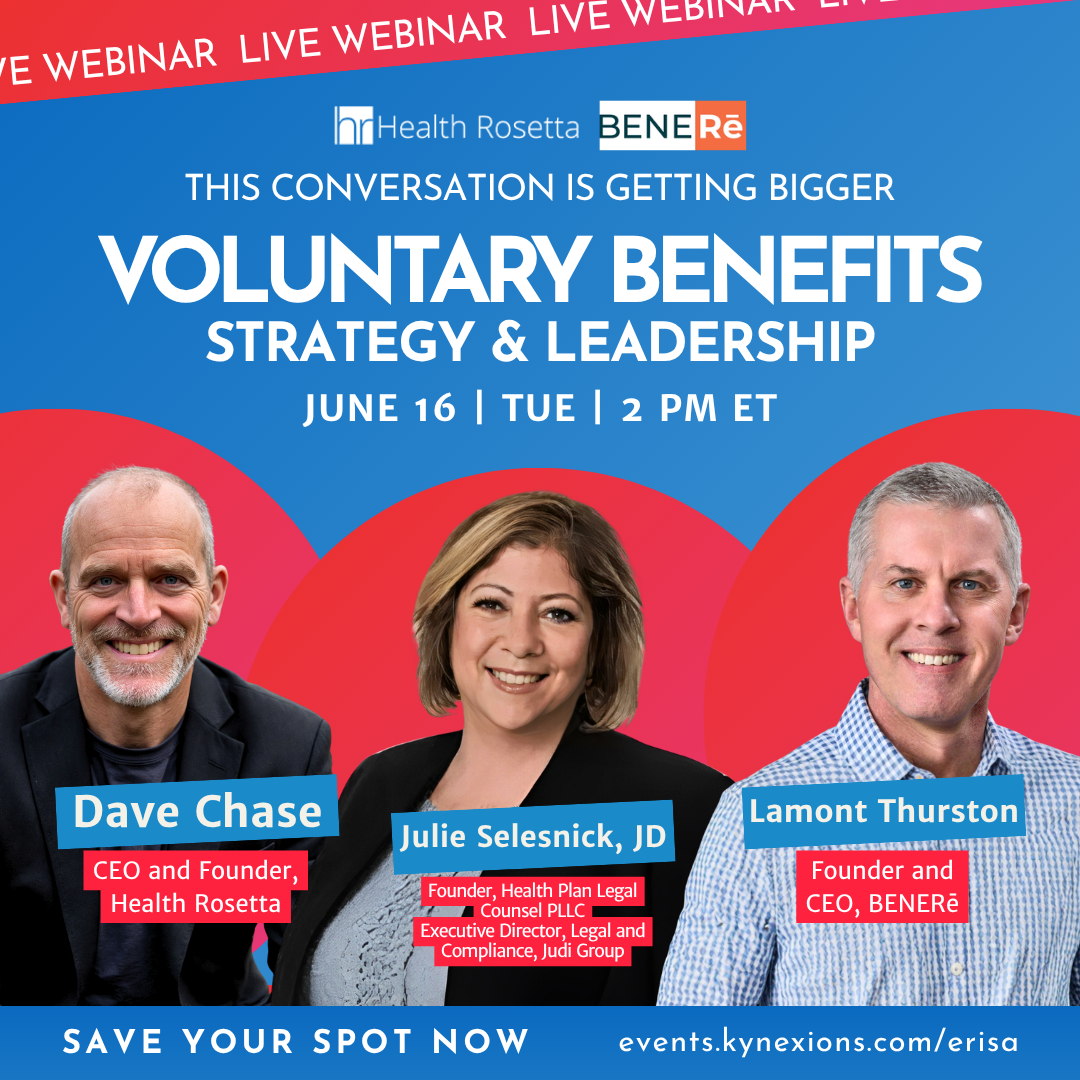
In a June 16 webinar, ERISA attorney Julie Selesnick and BeneRe founder Lamont Thurston joined Dave Chase to unpack the growing wave of voluntary benefits litigation — and what employers can do right now to stay on the right side of it.
Watch the full session here: Voluntary Benefits Under Fire — Full Replay
Why This Conversation Matters Right Now
Five class action lawsuits filed in late 2025 have put voluntary benefits squarely in the crosshairs of ERISA litigation. The allegations are pointed: that employers and brokers put their own financial interests above employee interests by promoting high-commission, low-value plans. And unlike most benefits disputes, these cases do not involve improper claims handling. They focus on the failure to prudently select and monitor products — and the failure to ensure broker compensation was reasonable.
As Julie Selesnick put it plainly during the session: if you think your voluntary benefits program is sitting safely in the ERISA safe harbor right now, there is a strong chance you are wrong.
“80% of voluntary benefit programs that employers think are exempt from ERISA are not. Most of them fall outside the safe harbor because of something the employer is already doing.”
— Julie Selesnick, Health Plan Legal Counsel PLLC
The Four Requirements for the ERISA Safe Harbor — And Why Most Plans Fail
ERISA provides an exemption for voluntary benefits when four conditions are met. All four must be satisfied. And the third one, according to Julie, is where most plans come apart.
- No employer or plan sponsor contributions toward premiums
- Employee participation must be completely voluntary — employees cannot feel they are expected to enroll
- The employer must play a non-endorsing role — this means no negotiating rates or terms with carriers, no including voluntary benefits alongside non-voluntary benefits in enrollment materials, no sending premium notices, and no helping employees with claims
- No profit incentive to the employer — only reasonable reimbursement for payroll administration costs
That third element is the one that trips employers up most often. Including voluntary benefit information in your standard open enrollment package — even if you have done it for years — can be enough to take the plan outside the safe harbor. The Department of Labor and the courts have been clear about this.
“The reason I’m going over those is to point out how hard it is to stay in the safe harbor. It’s really worth doing a cost-benefit analysis. What are you trying to gain by keeping this exempt from ERISA, and is it worth it given the litigation environment we are now in?”
— Julie Selesnick
The Captive Solution: Where BeneRe Comes In
The litigation environment is not an argument against offering voluntary benefits. It is an argument for offering them the right way.
Lamont Thurston, whose organization BeneRe has approximately two million employees participating in group captive voluntary benefit arrangements, made the case that the captive model solves for precisely the transparency and accountability gaps that are driving the lawsuits.
In the traditional voluntary benefits market, employees fund premiums that often run at 25 percent claims ratios or lower — meaning insurers and brokers absorb three quarters of every dollar employees pay in. There is little transparency into where the money goes, what the expenses are, or how the claims experience compares to what was promised.
The group captive model flips that structure. All expenses are disclosed. Claims funds exist specifically to pay claims. And when claims come in below projections, the remaining funds flow back as a premium offset for the following year or are reinvested as a plan asset — not returned to the carrier or retained by the broker.
“I call it the trust but verify environment. I trust that you brought me a good plan as a carrier and a great deal as a broker. But the verify is at the end of the year. If the claims do not materialize, it comes back.”
— Lamont Thurston, BeneRe
For employers managing 250 or more benefit-eligible employees, the math is compelling. Lamont walked through a real example: an employer who shifted from a PPO to an HDHP and redirected the premium savings toward a BeneRe voluntary benefits arrangement saved $93,750 in year one while providing employees with meaningfully stronger supplemental coverage.
Why Employees Need These Benefits — And Why the Answer Is Not to Stop Offering Them
Both speakers were clear that the litigation risk is not a reason to walk away from voluntary benefits. It is a reason to get them right.
Three statistics Julie cited from recent surveys frame the stakes for employees:
- 61% of employees say coverage for out-of-pocket medical and hospital expenses is very important to them
- 65% of employees have less than $1,000 on hand for any unexpected health expense
- 77% of employees say voluntary benefits are an important factor when deciding whether to accept or decline a job offer
As deductibles have roughly tripled over the past two decades, the market for supplemental coverage has grown at the same pace — from approximately $4 billion in the mid-2000s to roughly $12 billion today. The demand is real, the need is real, and employees are counting on employers to get the selection and administration right.
What Dave Chase Called a Once-in-a-Career Opportunity
Dave Chase framed the voluntary benefits litigation moment as a parallel to what happened in retirement benefits a generation ago. The advisors who leaned into fiduciary duty early — who saw the regulatory handwriting on the wall and built their practices around transparency and genuine client advocacy — won. The ones who clung to the commission-driven model did not.
“In my career, every time the people who play offense on the new realm win. Healthcare is always 20 years behind just about every other industry. It is just coming to healthcare now. And the same opportunity is here.”
— Dave Chase, Health Rosetta
For Health Rosetta advisors, this is not a defensive moment. It is a competitive one. The employers who want accountability, transparency, and a benefits program that genuinely protects their people are looking for advisors who can deliver it. The litigation environment is accelerating that search.
Three Steps Employers and Advisors Should Take Right Now
For employers and their advisors, Julie closed with a clear action framework:
- Confirm the ERISA status of your voluntary benefits program. Do not assume you are in the safe harbor. Assume you are not, and work backward from there.
- Get a compensation disclosure from your broker. Determine what portion of the premiums employees are paying flows to the broker as compensation, and assess whether it is reasonable given market standards.
- Assess the quality of what you are offering. How do your current voluntary benefit policies compare to what is available in the market? Are your employees getting meaningful financial protection or coverage that rarely pays out? That distinction matters — both for employee wellbeing and for what a court will eventually look at.
The litigation will continue to evolve. Julie expects it to move from voluntary benefits into dental, vision, and eventually health plans broadly — mirroring the arc of excessive fee litigation in the 401k space. The employers and advisors who are well-documented, transparent, and genuinely focused on employee value will not be the targets.
Watch the Full Session
The complete recording of Voluntary Benefits Under Fire is available now. Watch the replay here.
This conversation continues at RosettaFest 2026 in Nashville, July 29 to 31. The fiduciary and ERISA track goes deeper on these topics alongside sessions on direct specialty care, community-owned health plans, women’s health, and the Rosie Awards honoring America’s top health plans.
Get your ticket at RosettaFest.org.